






Beautiful Towns & Villages of the Fishermen's Trail
The Fishermen's Trail passes through a string of villages and towns between Porto Covo and Lagos. Rather than list every stop, here are six that are particularly worth building time around - for their history, their character, or simply for being unusually beautiful. Roughly north to south:
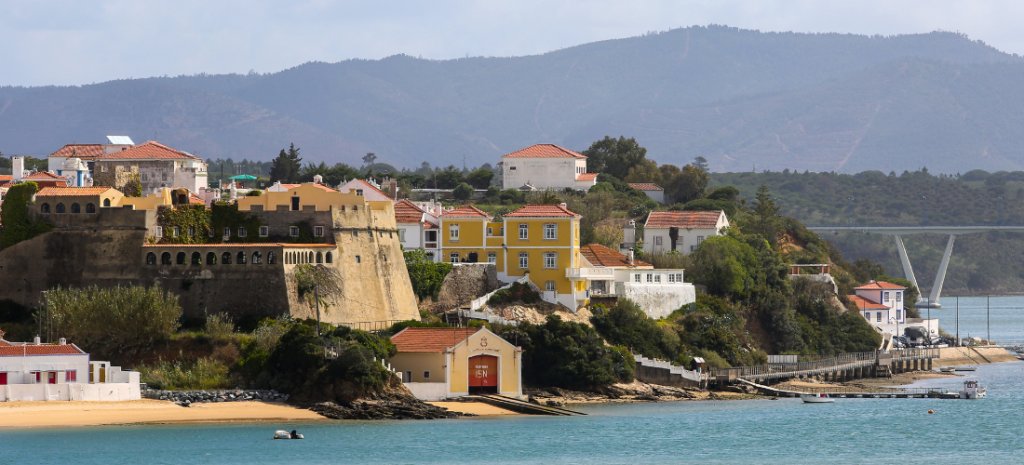
Vila Nova de Milfontes
Vila Nova de Milfontes sits where the River Mira widens into a broad estuary before reaching the Atlantic, its whitewashed centre climbing gently above the water. King John II founded it by royal decree in 1486, as a couto de homiziados - a settlement where outlaws could win pardon for their crimes in exchange for helping defend the coast against pirates. It didn't entirely work: a major corsair attack largely destroyed the town in 1590, which is why Fort São Clemente, a modest fortress above the river mouth, exists at all.
Today it's a place for wandering old streets, watching the light change on the water, and taking the summer ferry across to Praia das Furnas.
Don't miss: Fort São Clemente (Wikipedia.org), and the short ferry crossing to Praia das Furnas on the opposite bank.
Keep your eyes peeled for: Local painters at easels near the river, particularly around the small square by the old aviation monument - the view over the water has drawn them for decades.
.png)
Aljezur
A whitewashed old quarter climbs to Aljezur Castle (Visitportugal.com), a ruined Moorish castle on one side of the valley. The castle's history runs deeper than its Islamic-era construction - excavations have turned up Bronze and Iron Age occupation, then Roman and Visigothic use, before the fortress you see today was built in the 10th century. The climb up is short and steep, and the view over the valley from the top is the best in town.
Aljezur is also sweet potato country. The local variety, grown in a narrow coastal strip with a particular sandy-over-clay soil, carries EU Protected Geographical Indication status, and every November the town holds a sweet potato festival that draws thousands of visitors.
Don't miss: The climb up to the Moorish castle for the valley view.
Need to know: According to local legend, the knights who took Aljezur's castle from the Moors in 1249 drank a sweet-potato-based dish before battle - though the story doesn't fit the known history of when sweet potatoes actually reached Europe. The legend is documented in the region's own official product records regardless.
Keep your eyes peeled for: The sweet potato itself on restaurant menus - reddish-purple skin, deep yellow flesh - turning up roasted, fried, or in local desserts.
.png)
Arrifana
A small fishing-village-turned-surf-town, tucked below a plateau. The headland above has been settled since Phoenician and Roman times, but what remains today is the ruin of a 12th-century Ribat - an Islamic fortress-monastery traditionally attributed to the Sufi mystic Ibn Qasî, and the only fortress of its kind identified in Portugal (Cm-aljezur.pt). Archaeologists date its construction to around 1130 and its abandonment from 1151 onwards - a working life of barely twenty years.
Down at sea level, the village itself is unpretentious: a beach, a handful of restaurants, and a community of surfers.
Don't miss: the Ribat ruins on the headland above the beach - one of the trail's highlights.
Insider tip: Go up in the late afternoon rather than midday - the light across the ruins and out to sea is better, and the surf crowd thins out as the day cools.
.png)
Carrapateira
Fishermen, farmers and surfers share the same square here, old and new Carrapateira sitting comfortably alongside each other. The Museu do Mar e da Terra, up a steep lane near the top of the village, covers the older story: fishing tools, farming implements, and photographs of a life that was, by all accounts, hard.
Just outside the village is Pedralva (Aldeiadapedralva.com), worth the detour on its own. By 2006 it had shrunk to nine residents, its fifty-odd houses mostly in an advanced state of disrepair. Rather than being left to disappear, it was bought up house by house - negotiating with more than 200 scattered owners and heirs - and rebuilt over the following years. It's now restored as a small rural tourism village, with a restaurant, a café, and guest cottages named after the region's beaches.
Don't miss: Pedralva - worth the short detour even if you only stop for lunch.Keep your eyes peeled for: the individual character of each restored house in Pedralva - several still incorporate furniture and fittings recovered from the original ruins.
.png)
Sagres
Sagres has been closely associated with Prince Henry the Navigator since the 15th century, when he established himself in the region and the fortress on the headland was built. The town's outward-looking reputation partly rests on the famous "School of Sagres" story - though historians now regard the idea of a formal navigation school here as largely a later legend rather than documented fact. What isn't in dispute is the Rose of the Winds, a vast stone compass uncovered within the fortress walls in the early 20th century, whose exact purpose is still debated.
Below the town, the fishing harbour at Baleeira is still genuinely working - boats come in through the morning, and a fish auction runs most afternoons.
Don't miss: Sagres Fortress and the Rose of the Winds within its walls (Museusemonumentos.pt).
Insider tip: Head down to Porto da Baleeira in the afternoon to watch the fishing boats unload and the auction get underway.
Keep your eyes peeled for: The fishing boats themselves - Baleeira takes its name from baleia, meaning ‘whale’ in Portuguese, after the whaling this harbour once supported.
.png)
Lagos
The trail's final stop, and a proper historic town rather than a village - walled, layered, and significant to Portuguese history. It was from Lagos's natural harbour that several Age of Discoveries expeditions set sail, and Henry the Navigator was based here for years, directing voyages into the Atlantic.
That history has a difficult side the town doesn't hide from. In 1444, one of the first large shipments of enslaved Africans brought to Portugal from West Africa arrived and was sold in Lagos, an early and significant episode in what became the European slave trade. The building known today as the Mercado de Escravos wasn't built until 1691, originally as a customs house; the actual 15th-century trading took place in the open square nearby, now Praça do Infante Dom Henrique. The building now houses a small, carefully presented museum on this history.
Don't miss: A walk along the old town walls, and the Mercado de Escravos museum (Museu.cm-lagos.pt) for the fuller picture of the town's history.
Keep your eyes peeled for: Blue-and-white azulejo tilework on building façades throughout the old town. The tradition itself traces back to Moorish craftsmanship - the word comes from the Arabic for "polished stone" - though the now-iconic blue-and-white palette only took hold later, during the Age of Discoveries, as Chinese porcelain and Dutch tiles began reaching Portuguese shores (Invaluable.com).

Director & Founder
Ever since I first set foot in Spain way back in 1988, I have been fascinated by the different landscapes this country has to offer. My first love was the Picos de Europa mountain range, in northern Spain, where I began doing field work as an anthropologist and ended up designing walking and cycling tours for a Dutch tour operator. Many more tours have followed since and I have explored many many corners of Spain and Portugal, including islands. Wherever I go, I have never been disappointed by the trails, the views, the culture, the food and the hospitality of each area. It’s a pleasure to be able to share my love and professional knowledge of these countries with you. Please, be my guest!
Most popular








Contact
-
Edificio Sovega bajo, Crta General s/n
33554 Arenas de Cabrales
Asturias , Spaininfo@s-capetravel.eu
+34 (0) 985 846 455
UK call free 0800 707 44 35 -





Opening hours: Mon-Fri 9:00am – 6:00pm (CET)
Opening hours: Mon-Fri 9:00am – 6:00pm (CET)