






Best Beaches of the Fishermen's Trail
The Fishermen's Trail is, before it's anything else, a trail strung between beaches - you're rarely more than an hour from one, and the walking days are built around them almost as much as around the villages.
But not all of them are the same kind of beach: the character of the coast changes as you head south. And that's obviously important to know before you dip your toe in the water.
Here's an honest rundown, roughly north to south.
The Alentejo Beaches: Exposed Atlantic, With a Few Calm Exceptions
The stretch from Porto Covo down to Odeceixe is dune country - vast, wild, and largely undeveloped. Most of it is a surfers' coast rather than a swimmers' one: strong currents and real Atlantic swell are the whole point of these beaches for the people who come here for them, and our team treats the open sea here with real caution. But it's not a blanket rule - a couple of the best beaches on this stretch have a genuine calm-water side, and it's worth knowing which ones before you write the whole section off.
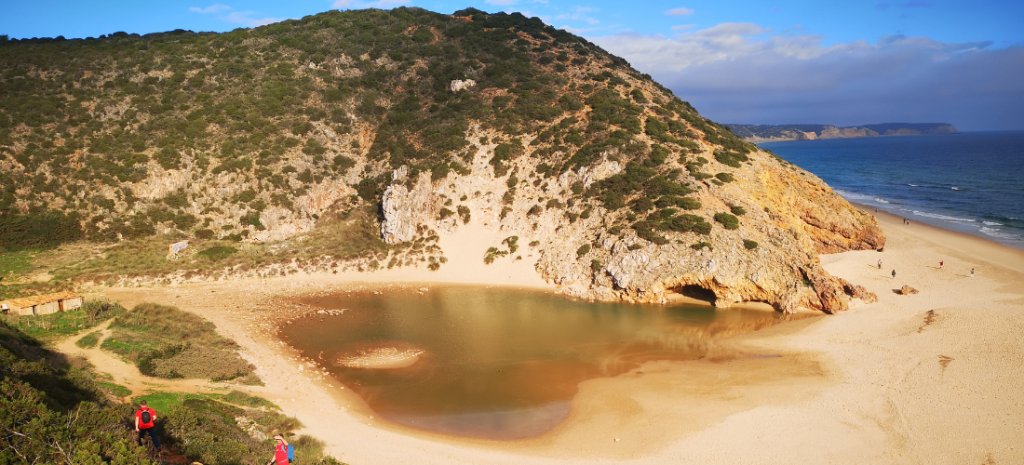
Praia das Furnas
The first proper beach most walkers see, just outside Vila Nova de Milfontes, reached by ferry across the River Mira before the trail even properly starts. Furnas is really two beaches in one: one side faces the sheltered Mira estuary, calm and genuinely swimmable, while the other opens onto the Atlantic proper. If you want a swim on the northern half of the trail, this is one of the better places to actually get it.
The Dunes of Ilha do Pessegueiro
Not a single beach so much as a whole stretch of dramatic dune coastline near Porto Covo. What strikes me every time is the vegetation - pines, rosemary, wild sunflower - all bent almost sideways by the near-constant wind. The small island just offshore has its own quiet history, too: it's believed to take its name from the Latin piscatorius, after a Roman fish-salting operation that once ran there.
Praia da Amália
South again, near Zambujeira do Mar, this one has a story behind its name that most visitors never hear. It used to be called Praia da Assenha, until Portugal's most celebrated fado singer, Amália Rodrigues, bought the cliff above it in the 1960s for a holiday home - and, rather than fencing it off, kept the beach open to anyone who found their way down. It's still a proper trek to reach, and quiet as a result, but her name stuck.
Further south still, between Zambujeira and Odeceixe, the trail strings together a run of quieter beaches - Alteirinhos, Carvalhal and Machados - that most visitors to the region never see, simply because they're only accessible on foot or by very local knowledge.
The Middle Section: Where the Coast Starts to Soften
Around Aljezur and Carrapateira, the character starts to shift.
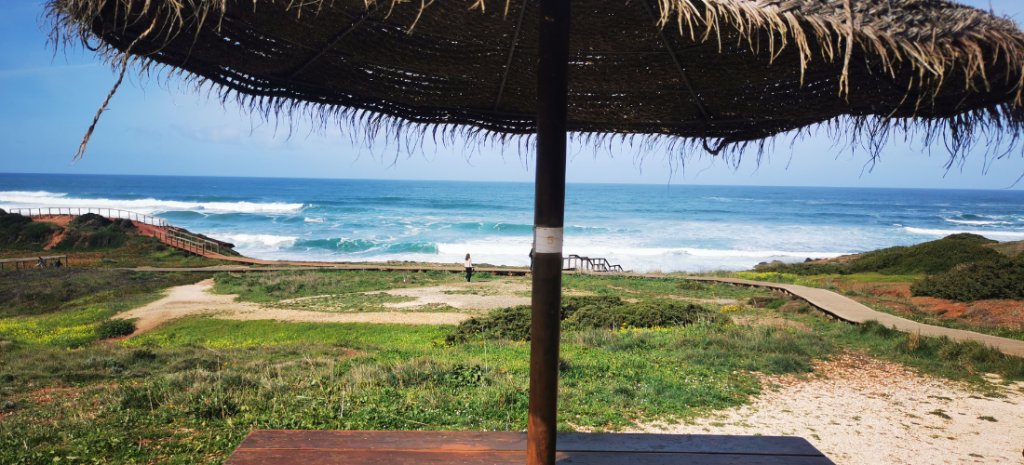
Praia da Amoreira
Roughly halfway between Carrapateira and Vila do Bispo, this is a genuine local favourite - a proper beach bar, a viewpoint above it, and a following among surfers rather than sunbathers. It's also, like Furnas, a two-sided beach: the Aljezur river forms a warm, shallow lagoon at its southern end, calm enough for children, and a genuine spot to see otters, herons and kingfishers if you're patient. Monte Clérigo, passed earlier on the Aljezur–Arrifana stage, is quieter still and worth a mention in the same breath.
Bordeira
An enormous stretch of sand near Carrapateira - at over 3 kilometres, the longest beach in the whole Aljezur municipality, and it looks it. Like Amoreira, there's a gentler side to it: a river forms a warm, shallow lagoon at the southern end, sheltered enough for children, while the open beach to the north draws serious surfers into genuine Atlantic swell.
Praia do Amado
Arguably the most photogenic beach on the whole trail. The contrast here is what stays with people: pale gold sand shading into a striking red-earth coastline, especially dramatic at sunset, with the blue of the sea and sky sitting against it. Wooden boardwalks lead down to a viewpoint above the beach, part of an ongoing effort to protect the dune vegetation from foot traffic. Amado is a serious surf beach in its own right, so - beautiful to look at and walk beside, less straightforward to swim from.
The Algarve Beaches: This Is Where You Actually Swim
Here's the honest geography of it: the coastline properly calms down once you round the corner past Sagres into the Algarve, and that's where the trail's best, reliable swimming beaches are.
.png)
Martinhal, Barranco, Ingrina & Figueira
Between the towns of Sagres and Salema - one of the more demanding stages, cliff-wise - you pass a genuine cluster of swimmable beaches, each a little different in size and shelter, but all calm enough for a proper dip after a hot day's walking. If you've been saving your swimsuit for later in the trip, this is the stretch where it finally earns its place in the pack.
Zavial
A quieter beach on the same stretch, and one with a startling history for somewhere this peaceful. In August 1759, during the Seven Years' War, a French warship called the Redoutable was deliberately run aground here while fleeing a British fleet, and burned where it lay - a sister ship met the same fate at Almádena, just along the coast. It's genuinely strange to stand on quiet sand and picture cannon fire offshore.
Praia do Camilo
The trail's last beach highlight, right at the end near Lagos: small, sheltered, and tucked beside the sea caves and arches of Ponta de Piedade. Its best-known feature is a narrow tunnel through the rock at one end, passable at low tide, leading through to a second, smaller cove that most visitors never find. About as good a note as any to finish a week or two of walking on.
A Few Wild Ones
Away from the named highlights, there are stretches of coastline - particularly in the quieter run before Vila Nova de Milfontes - that remain genuinely wild and undeveloped: no facilities, no crowds, just sand and cliff and whatever wildlife happens to be about that day. Part of the appeal of walking the trail rather than driving the coast road is that these are the beaches you'd otherwise never find.
If beach time matters as much to you as the walking does, it's worth knowing this pattern before you plan a route: the northern section, Porto Covo to Arrifana, is scenery-first, swim-second; the southern section, Arrifana to Lagos, is where you find the majority of the best beaches. Walking the full trail means you get both - the wild approach and the reward at the end of it.

Director & Founder
Ever since I first set foot in Spain way back in 1988, I have been fascinated by the different landscapes this country has to offer. My first love was the Picos de Europa mountain range, in northern Spain, where I began doing field work as an anthropologist and ended up designing walking and cycling tours for a Dutch tour operator. Many more tours have followed since and I have explored many many corners of Spain and Portugal, including islands. Wherever I go, I have never been disappointed by the trails, the views, the culture, the food and the hospitality of each area. It’s a pleasure to be able to share my love and professional knowledge of these countries with you. Please, be my guest!
Most popular








Contact
-
Edificio Sovega bajo, Crta General s/n
33554 Arenas de Cabrales
Asturias , Spaininfo@s-capetravel.eu
+34 (0) 985 846 455
UK call free 0800 707 44 35 -





Opening hours: Mon-Fri 9:00am – 6:00pm (CET)
Opening hours: Mon-Fri 9:00am – 6:00pm (CET)