






Best long-distance cycling routes in Spain
Spain has hundreds of long-distance cycling routes worth riding, but six stand out for the range of terrain, history and difficulty they offer - three of them Camino de Santiago routes, one obscure wool-trade path, one Andalusian classic built by cyclists for cyclists, and one loop through Catalonia's volcanoes and coast.
Each can be ridden in stages of your own choosing. None of them demand you finish in one go - a common approach is to complete a route in sections over several trips, adjusting daily distance to fitness and time available.
| Route | Distance | Difficulty | Best for |
| Camino del Norte | ~830km | Moderate–Hard | Coastal scenery and historic cities |
| Camino Primitivo | ~320km | Hard | Experienced climbers and quieter pilgrimage |
| Camino Francés | ~750km | Moderate | First long-distance cycle tours |
| Ruta de la Lana | ~700km | Moderate–Hard | Solitude and historic inland Spain |
| TransAndalus | 2,000+ km | Very Hard | Experienced mountain bikers |
| Pirinexus | ~340km | Easy–Moderate | Greenways, relaxed touring and varied scenery |
Camino del Norte - Cliffs, Coves & Cathedrals
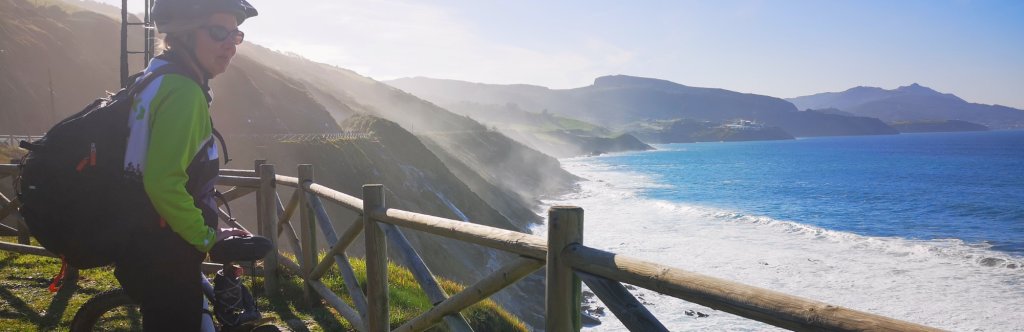
The Camino del Norte is arguably the most varied of Spain's pilgrim routes. It runs along the Basque, Cantabrian and Asturian coast before cutting inland through Galicia to Santiago - passing through San Sebastián, Bilbao, Santander and Oviedo along the way.
For two-thirds of its length, the route hugs the sea - climbing out of one fishing village and dropping into the next, cliff after cliff. Only past Ribadeo, on the Galician border, does it turn inland for a gentler final run to Santiago.
Because the Camino was designed for walkers, cyclists need to plan detours around sections where the trail is unrideable - usually by switching to parallel local roads rather than carrying a bike by hand. The workaround barely dents the experience.
Need to know: The full route runs to roughly 830km. Cyclists typically compress it into 14–20 stages - about half the number of days a walker would need, since a single day in the saddle covers what takes pilgrims 2–4 days on foot.
How is a Camino cycling stage different from a walking stage? Cycling stages are typically 40–60km, roughly 2–4 times the distance of a walking day - which is why the same Camino can be "16 stages" for a cyclist and "30-plus" for someone on foot.
Insider tip: North Spain's hostel and hotel network largely shuts for winter, so plan for a March–October window if you want fixed accommodation.
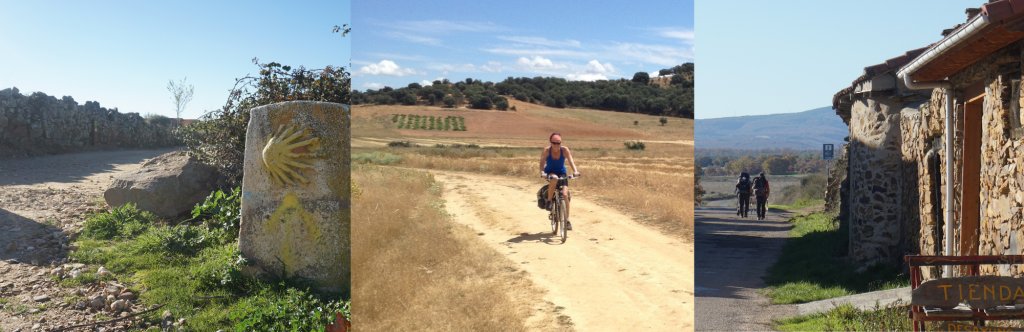
Keep your eyes peeled for... Scallop shells set into pavement rather than painted on. In Asturias in particular, local tradition holds that the shell's longest groove points the way to Santiago - a subtle piece of wayfinding many first-time riders never notice.
Camino Primitivo - The Original & Hardest
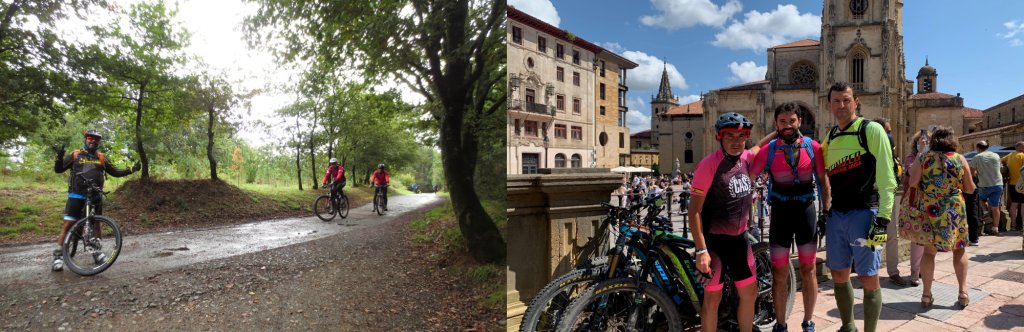
The Camino Primitivo is the original Camino, and also the toughest one to cycle. The Puerto del Palo alone gains 625m to reach 1,146m, and the climbing doesn't let up much either side of it.
That difficulty is exactly why some pilgrims choose it. It's less crowded than the Francés or even the Norte, crosses genuinely rural Asturias and Galicia, and rewards the physical effort with a sense of having earned the arrival in Santiago.
Despite the remoteness, infrastructure has improved substantially in recent years - this isn't an under-served route, just a quiet one, at least until it merges with the Camino Francés at Melide for the final stretch into Santiago.
Need to know: At around 320km, it's the shortest of the three Caminos here - typically ridden in 6 stages or 9 stages, with daily distances of 25–70km depending on how tightly you compress it.
Insider tip: Book ahead for the last two days. Once you join the French Way at Melide, hostel and hotel availability tightens fast.
Keep your eyes peeled for... Roman gold-mining scars. Near the Puerto del Palo and on toward Grandas de Salime, the hills were reshaped by Roman hydraulic gold mining almost 2,000 years ago - one of the small lakes near the pass is itself a Roman-era water store built for the operation.
Camino Francés - Spain's Busiest Pilgrim Road
The Camino Francés is the route most people picture when they think "Camino" - 750km from Roncesvalles to Santiago, and the obvious starting point for anyone new to long-distance cycle touring. Its popularity comes with an upside: more infrastructure per kilometre than any other route on this list.
That popularity is also its main practical complication. Albergues fill quickly in peak season, and walkers get priority over cyclists at most of them - a detail worth knowing before you commit to a fixed nightly plan.
The terrain itself is comparatively forgiving. A couple of stretches climb hard - notably the approach to O Cebreiro - but most of the route is graded for volume, not difficulty, which is part of why it supports so much daily traffic.
Need to know: Most cyclists ride it in around 14 stages, averaging 45–55km a day, though the dense network of accommodation makes it easy to shorten or lengthen almost any stage on the fly.
Insider tip: Spring and autumn bring the best balance of weather and crowding. If you're set on summer, the Francés is one of the few Caminos where camping is a realistic backup when albergues fill.
Keep your eyes peeled for... The "chicken miracle" at Santo Domingo de la Calzada. The cathedral keeps live chickens in a coop, commemorating a medieval miracle associated with St Dominic - one of the Camino's stranger traditions, and one that catches many cyclists by surprise.
La Ruta de la Lana - the Wool Road (Almost) Nobody Rides
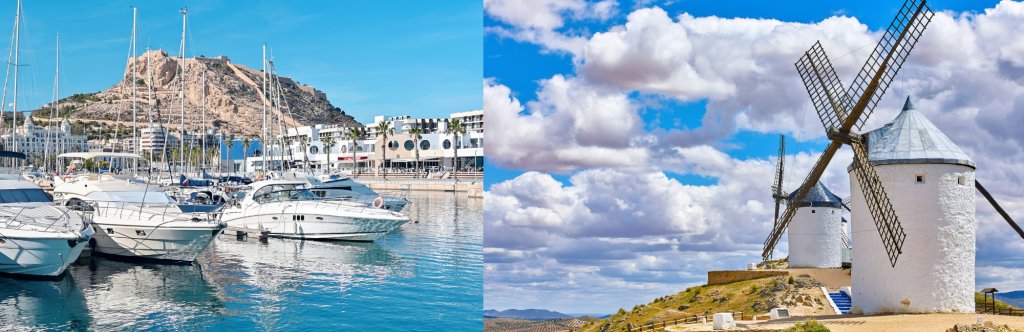
The least-known route on this list, the Ruta de la Lana takes its name from the transhumance trade it once served - an old droving path used to move wool from Alicante to Burgos, later adopted as a pilgrim route in its own right.
It cuts a near-diagonal line across the peninsula, through countryside few cycling visitors ever see. If solitude is the goal, this is the route: 700km with barely another rider in sight, and once in Burgos, the option to pick up the Camino Francés toward Santiago.
The trade-off is self-sufficiency. Villages thin out for long stretches, so summer riders need to carry serious water reserves, and tent-based travel is a realistic default rather than a niche choice.
Need to know: A typical medium-difficulty breakdown runs to 11 stages, averaging 60–65km a day with some genuinely demanding climbs - Salmerón to Mandayona alone gains nearly 1,200m.
Insider tip: Plan every stage's water and food before you set off - this isn't a route where you can improvise a resupply.
Keep your eyes peeled for... Ancient drove roads, or 'cañadas reales'. Much of the route follows livestock highways protected by law since medieval times - a cañada real can legally run up to 75 metres wide, room enough for the thousands of sheep that once migrated along it each year.
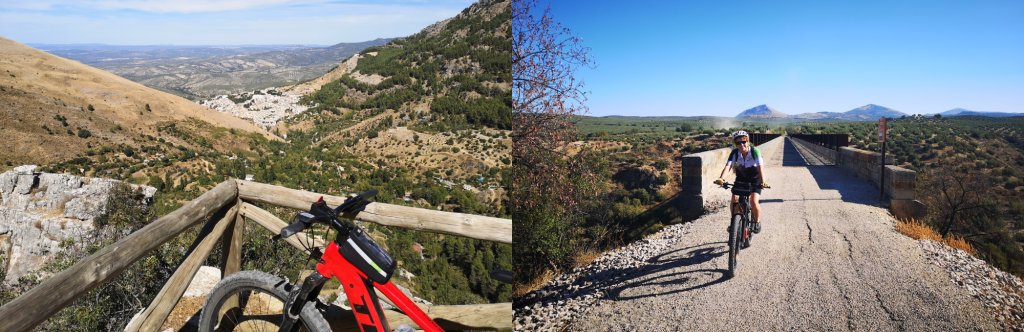
TransAndalus - Built By Cyclists, For Cyclists
Unlike the Caminos, the TransAndalus was designed from scratch for cycling - a circular route of more than 2,000km through Andalusia, running mostly along dirt tracks, cattle trails and forest paths rather than pilgrim infrastructure.
It shows in the riding. This is mountain bike territory, self-guided and unsignposted, which means GPS tracks aren't optional - they're the only way to follow it.
The reward for that extra planning is a version of Andalusia most tourists never see: whitewashed hill towns, cork forests, the Alpujarras, all linked by tracks built for exactly this purpose.
Need to know: The official route runs 23 stages; a more forgiving 39-stage breakdown keeps daily distances to 29–84km, with some serious climbing - several days gain over 1,500m.
Insider tip: Time your Andalusian summer riding for early morning. Temperatures here go further into extreme heat than almost anywhere else on this list.
Keep your eyes peeled for... Cork harvesting. Riding through the cork oak forests in June or July, you may see the bark being stripped by hand - the vivid orange trunks aren't diseased, they're freshly harvested and will regenerate over the next decade (Malaga.es).
Pirinexus - Volcanoes to the Mediterranean
Named for the way it links the Pyrenees with the sea, the Pirinexus is Girona province's signature long-distance cycle network - 340km of vías verdes, coastal roads and rural lanes through one of Catalonia's most varied corners.
More than a third of the route runs along old railway lines converted into flat, traffic-free greenways. Two different ones, in fact: a former line to Sant Feliu de Guíxols on the coast, which opened in 1892 and once carried cork from inland forests down to port, and a separate line between Olot and Girona, opened in 1911, tracing the Ter, Brugent and Fluvià rivers.
Between the two greenways, the route touches almost every register of Catalan landscape. It passes Pals, whose walls look out over rice paddies farmed since the 15th century. It calls at Banyoles, Catalonia's largest natural lake, which hosted rowing at the 1992 Barcelona Olympics. And it climbs into the Garrotxa Volcanic Zone, where a small Romanesque hermitage sits inside the crater of the extinct Santa Margarida volcano, 682m up, in a meadow ringed by forest.
Need to know: The full loop runs to 340km, typically ridden over 6–7 cycling days between Girona, the Costa Brava coast and La Garrotxa. Terrain is mostly flat to gently rolling, thanks to the greenway sections, with one longer climbing day into the volcanic park.
What is a via verde? Spain's "greenways" are disused railway lines converted into traffic-free paths for cycling and walking - flat, well-surfaced, and often the gentlest way to cover long distances by bike.
Insider tip: Time a visit to Pals for spring, when the village holds its annual rice festival and local restaurants build menus around the harvest.
Best time to cycle the Pirinexus: Late April through June is worth prioritising if timing allows - it overlaps with the Pals rice festival and avoids the height of summer heat on the coastal stretch, though the route is rideable from March to late October.
Keep your eyes peeled for... Volcanic stone villages. Around Olot and Santa Pau, many houses, churches and even streets are built from dark volcanic basalt quarried locally - once you notice it, the region has an architectural character unlike anywhere else in Catalonia.
Four Things to Pack, Whichever Route You Choose
- Panniers, properly balanced. Weight distribution matters more than total weight - you'll feel a poorly loaded bike within the first few kilometres.
- A plan for where you'll sleep or camp. Check local camping regulations before assuming wild camping is an option.
- The lightest gear you can justify. If long-distance touring becomes a habit, every gram saved in tent, sleeping bag and cooker pays for itself.
- Visibility, day and night. Long stretches of these routes run on open roads - lights and reflective gear after dark, bright clothing in daylight.
Frequently Asked Questions
How long does it take to cycle a Camino de Santiago route? Most cyclists ride a Camino in 6 to 20 stages depending on the route and daily distance chosen - typically half the number of days a walker would need, since cycling stages cover 2–4 times the ground.
Which Camino is best for a first long-distance cycling trip? The Camino Francés, thanks to its dense accommodation network and comparatively gentle terrain - though it's also the busiest.
Is the TransAndalus suitable for a standard touring bike? No - its dirt tracks and cattle trails are built for mountain bikes, and the unsignposted route requires GPS navigation throughout.
Is the Pirinexus a good route for less experienced cyclists? Yes - the greenway sections in particular are flat, traffic-free and well surfaced, making it one of the more accessible routes on this list despite its length.
Like our pick of the best long-distance cycling routes in Spain, but looking for something a little shorter? Check out our full collection of self-guided Spanish cycling holidays.
Marketing, Web & Design
After studying in my hometown of Barcelona and spending several years abroad, I relocated in 2018 to Cabrales, a beautiful rural area in Northern Spain. I invite you to check out some photos of Cabrales to see the incredible views we enjoy from our office!
After a few years in reservations, I now manage the website and marketing for S-Cape Travel, where I handle design tasks, blog writing, and attend specialized travel fairs.
Most popular








Contact
-
Edificio Sovega bajo, Crta General s/n
33554 Arenas de Cabrales
Asturias , Spaininfo@s-capetravel.eu
+34 (0) 985 846 455
UK call free 0800 707 44 35 -





Opening hours: Mon-Fri 9:00am – 6:00pm (CET)
Opening hours: Mon-Fri 9:00am – 6:00pm (CET)