






Picos de Europa Cycling Routes - A Local Guide
The Picos de Europa and the surrounding area are best known for their superb walking routes, but they’re also a fantastic destination for cycling enthusiasts. Before you set off, however, it’s important to understand the basic rules and a few practical tips to ensure your ride is both safe and enjoyable.
Cycling routes in the Picos de Europa
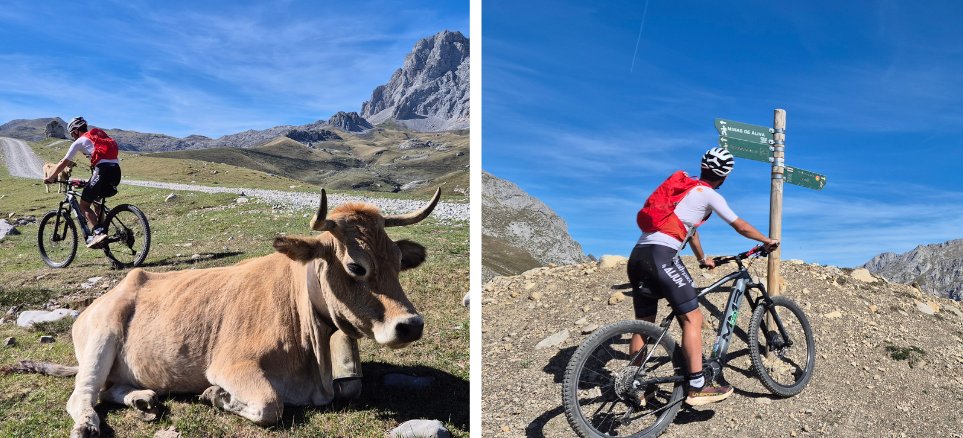
From Cabrales (Asturias) to Liébana (Cantabria)
15 km (one way) | 670–770 m ascent | MTB
The track that crosses the Eastern Massif from Sotres to Espinama is one of the most popular rides in the area. It is the only public mountain track where all types of vehicles are permitted (subject to certain rules, such as avoiding excessive dust).
The route is around 15 km long, with a steady ascent of approximately 770 metres if starting from Espinama, or 670 metres from Sotres. It’s easy to follow: take the turning from the final sharp bend before reaching Sotres, or join the track heading into the Picos from the centre of Espinama, perpendicular to the main road.
At the top, you’re rewarded with stunning views. The track itself is straightforward, allowing you to enjoy the landscape without constantly focusing on technical terrain. Only one slightly steeper section tends to have loose stones — particularly after rain — but otherwise it’s an accessible and enjoyable mountain ride.
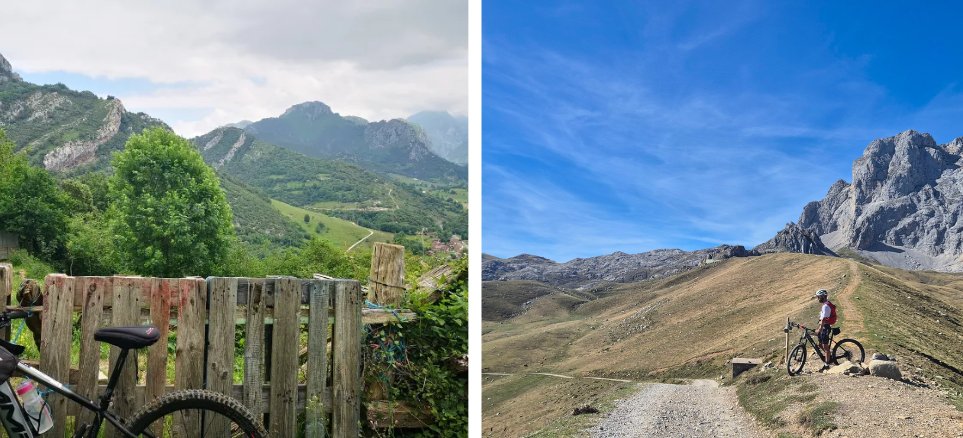
Eastern Massif circular route: Sotres – Potes – Bejes – Sotres
This circular route follows mountain tracks almost entirely, except for the section between Camaleño and Tama on the Cantabrian side of the Picos de Europa.
It is an extended version of the previous route and works particularly well over two stages:
Stage 1: Sotres (or Arenas de Cabrales) to Potes – 36 km, 1,350 m ascent
Stage 2: Potes to Arenas – 49 km, 1,875 m ascent
If you follow this suggestion, take the time to explore Potes, widely regarded as one of the most beautiful villages in Spain.
From Sotres, follow the road uphill to Hitu Escarandi, where the road continues towards Tresviso. Behind the car park at this point, a track descends to Bejes, passing through beech woodland, the pasture of La Llama and offering dramatic views high above the Urdón gorge. After the descent, a demanding climb leads up to Collado Pelea before reaching Potes.
The second stage begins with a series of climbs and descents through the scenic and culturally rich Camaleño valley, before joining the track that crosses the glacial Áliva valley (the first route described above) and returning to Sotres.
If you are staying in Arenas de Cabrales, the final stretch is a long 1,000-metre descent to the level of the River Cares, bringing you back into the village — a memorable way to end the ride.
.png)
Climb to Sotres
17 km (one way) | 1,020 m ascent | Road bike
For those who enjoy a real challenge, this is an unrelenting climb to one of the highest villages in Asturias - and one of the very few in Spain located within a National Park. There’s little respite along the way unless you choose to get off and push, but the scenery more than compensates for the effort.
Setting off from Arenas de Cabrales, you enter the National Park within just a few kilometres, following the course of the River Cares. The real climbing begins at Poncebos. The first section winds steadily upwards through lush woodland, accompanied by the River Duje, with towering rock walls rising on either side and barely a glimpse of sky above.
Beyond the village of Tielve, the landscape changes dramatically. The views suddenly open out, the trees fall away, and the scenery shifts to striking grey limestone - raw, expansive and unmistakably high mountain terrain.
Navigation couldn’t be simpler: it’s the single road connecting Arenas de Cabrales and Sotres.
If you still have some energy left after a well-earned stop at a bar in Sotres, continue climbing further up the road to experience an even broader sweep of mountain landscapes.
.png)
Lagos de Covadonga
18 km (one way) | 1,140 m ascent | Road bike
As mentioned earlier, the Lagos de Covadonga area is highly protected and welcomes thousands of visitors each year, so regulations are unlikely to become any more relaxed. Cycling options here are limited, but for road cyclists the climb to the lakes is entirely possible - and if you reach the top, you’ll have completed one of the most iconic ascents in Asturian cycling history.
You are permitted to cycle up to the end of the CO-4 regional road, where you’ll find a car park and the María Rosa bar - the classic finishing point of the climb.
At present, the only way to access the Lagos via mountain tracks is by joining an organised group. For example, guided electric bike routes operate from Benia de Onís to the Lagos de Covadonga.
.png)
The Picos Loop (mountain and road)
145 km circular | 4,660 m ascent | MTB (mixed terrain: mountain tracks and road)
Almost 150 kilometres encircling the three massifs of the Picos de Europa, combining mountain tracks with regional and national roads. It’s a serious challenge — achievable in a single long day for very strong riders, or more comfortably divided into stages, as you pass through several villages offering services and accommodation.
Option 1: Mixed terrain (MTB)
Starting from Arenas de Cabrales, begin with the road climb to Sotres, then join the track crossing the Picos to Espinama (the first route described earlier). From Espinama, continue by road to Fuente Dé, before taking another mountain track that runs almost as far as Santa Marina de Valdeón.
Be aware that this off-road section is not straightforward. At times it can become overgrown if it hasn’t been cleared, and progress may be slow. From there onwards, the remainder of the route follows the road and is largely downhill, aside from a 540-metre climb to the Panderrueda pass.
Option 2: Road-only route
This alternative extends the distance to around 200 km but reduces the total ascent to approximately 2,579 metres.
Again starting from Arenas de Cabrales, head by road to Panes, then follow the spectacular Hermida Gorge to Potes. From there, the route detours south towards Riaño, where you join the national road leading directly to Cangas de Onís. From Cangas, a regional road brings you back to Arenas.
Direction of travel
We recommend riding the loop in the direction Arenas – Espinama – Oseja de Sajambre – Cangas, rather than the reverse. This avoids a prolonged uphill stretch between Cangas de Onís and Oseja de Sajambre and reduces the likelihood of being constantly overtaken by traffic on a relatively narrow and winding road.
Cycling regulations
Within the Natural Park, cycling is only permitted on tracks that are suitable for motor vehicles and not signposted as prohibited to bicycles. It’s worth remembering that a footpath is not the same as a track, and not everything in Picos is rideable. Planning your route in advance is essential.
In the Picos de Europa, the following are prohibited:
- Riding off-trail or across open countryside
- Cycling on footpaths
- Cycling along the Senda del Cares, Senda del Arcediano and the Urdón trail, due to the high risk for both cyclists and walkers
- Reaching the Lagos de Covadonga by any route other than the main road. Once at the top, cycling is not permitted, although you may walk alongside your bike. Electric bikes are strictly prohibited.
Practical advice
Once you’re clear on where you can ride (we suggest some routes below), it’s time to prepare for the unexpected — accidents, sudden fog or being caught out after dark. The Picos de Europa is a stunning area with many well-trodden routes and plenty of visitors, but it is still high mountain terrain, so caution is always necessary. Key points to bear in mind:
- Carry a repair kit and a spare inner tube. It may sound obvious, yet many riders overlook it. On the road you’re less likely to have issues, but in the mountains it’s indispensable.
- Alternatively, opt for tyres with built-in gel puncture protection. They may weigh slightly more than standard tyres, but the added protection can save you time and effort - and spare you a fair bit of stress - by significantly reducing the risk of punctures.
- Pack warm clothing. Weather can change rapidly — cold, rain and especially fog can roll in without warning and may force you to stop for several hours before it’s safe to continue.
- Use a secure phone mount to follow your route. Having your phone firmly attached to the handlebars makes navigation much easier. If you don’t have one, we list several local shops and workshops at the end of this article where you can buy one.
- Study your route carefully before setting out. Assess your fitness level and pay close attention to distances and elevation gain. Some climbs can feel never-ending.
- Take sufficient water and food. Don’t skimp on water — even at altitude, summer days can be very hot, and some sections offer very little shade.
With a bit of preparation and respect for the regulations, cycling in the Picos de Europa can be a truly rewarding experience.
Electric bikes in the Picos de Europa
An electric bike with pedal assistance allows many cyclists to tackle gradients they might otherwise avoid. As e-bikes become increasingly common — and more people travel with them by car — most accommodation providers are used to hosting them, often offering secure storage and facilities for charging batteries.
If you’re travelling to the Picos de Europa with an electric bike, here are a few useful tips:
- Manage your battery carefully to avoid running out of assistance mid-route, particularly on longer mountain rides with significant elevation gain.
- Plan your overnight charging. Some hotels provide dedicated sockets for charging bikes. In smaller guesthouses, you may need to remove the battery and charge it in your room. If your bike doesn’t have a removable battery, it’s best to check with your accommodation in advance.
- At the Lagos de Covadonga, electric bikes are strictly prohibited, even if you are walking alongside the bike and not riding it.
Bike shops and workshops around the Picos de Europa
If you need equipment, repairs or hire services, you’ll find several options in the area:
- BikePicos - Arenas de Cabrales, Asturias
- Camping El Cares - Santa Marina de Valdeón, León
- El Portal de Picos - Potes, Cantabria
- RanaSella - Arriondas, Asturias
- BRB Sport – Cangas de Onís, Asturias
Whether you’re hiring, repairing or simply looking for local advice, these businesses can help you make the most of your cycling experience in the Picos.
Are you ready to take on the Picos? We can help you organise your trip to the area, including accommodation and bike hire. We also offer routes with fewer ascents if you’re looking for a gentler challenge.
Get in touch to start planning your adventure!
Marketing, Web & Design
After studying in my hometown of Barcelona and spending several years abroad, I relocated in 2018 to Cabrales, a beautiful rural area in Northern Spain. I invite you to check out some photos of Cabrales to see the incredible views we enjoy from our office!
After a few years in reservations, I now manage the website and marketing for S-Cape Travel, where I handle design tasks, blog writing, and attend specialized travel fairs.
Most popular








Contact
-
Edificio Sovega bajo, Crta General s/n
33554 Arenas de Cabrales
Asturias , Spaininfo@s-capetravel.eu
+34 (0) 985 846 455
UK call free 0800 707 44 35 -





Opening hours: Mon-Fri 9:00am – 6:00pm (CET)
Opening hours: Mon-Fri 9:00am – 6:00pm (CET)